Friday, April 11, 2014

Putting the framework into words


I've been tackling my least favourite part of the thesis process - the theory chapter. This is also the chapter my supervisors emphasise as the framework of the thesis. But it's hard trying to work out exactly what my theoretical basis is going to be.

My supervisors have thrown phrases around like 'theory think-piece', or 'conceptualisation piece', which seem to make sense when we're discussing it in the meeting, but by the next day sound like another language. Then I get frustrated with myself because I can't put a finger on what my approach is exactly. I want to use discourses...so poststructuralism... so social constructionism gets a mention... what about citizenship? Where does that fit in - the lit review or the theory chapter? Or both? What about other aspects? Bourdieu? Arendt? Connectedness or belonging? Or should I focus on participation?

(Cue thoughts of "I don't know anything!". Impostor syndrome anyone?)

The more I think about it, the more confused I feel - and the more I feel I need to read! As a result, I have a stack of articles added to the stack of library books to read. Reading what others have written about my topic (digital citizenship, btw) and trying to identify their theoretical approach is helping me identify at least some approaches. I also spent a while writing down statements about my topic and then trying to identify my underlying assumptions and therefore my approach.  I put it all into a chapter outline, albeit skeletal - I really do have a LOT of reading to do. I'll slowly fill in the gaps and someday in a few years I'll have a finished theory chapter as part of my finished thesis - I hope!

So anyone else have this problem? Or maybe this is just my own peculiar weakness :)


Wednesday, April 9, 2014

Getting in touch

By Keely Blanch

Phew, we're slowly getting things up and running.

We've now initiated a Facebook group called 'UOCE Postgrads' and a link is on the sidebar if you'd like to join that. We're hoping the FB group can become a supportive social environment for Otago Education postgrads. We'll also be putting links to new blog posts on this group page.

But I don't use facebook, you say? No problems - we have another link on the sidebar for you to subscribe by email to new posts. This is done through Feedburner and we do not have access to your email addresses. And don't worry - you won't be spammed! No new posts = no email. :)

Got something you'd like to share? Or want to become an author on the blog? Drop us an email via the contact form over on the bottom of the sidebar, or post a comment, or post on the FB group.


Bitten!

By Lara Sanderson

Good Afternoon fellow Postgraders!
This post is all about the free stuff! Yes, FREE! A free book called BITE: Recipes for remarkable research I found it via Thesis Whisperer (on Facebook) - a very valuable Like for those who Facebook with lots of links to articles, tips on getting through your thesis etc. Anyway one of the links was to a book review to BITE which is a free book and from the look of the contents page - awesome for pg student and supervisor a like! I didn't link you to the article, just the book and it is below (copy and paste it)

https://www.sensepublishers.com/catalogs/bookseries/other-books/bite/

I hope you all get suitably bitten by this book!


Wednesday, April 2, 2014

Postgrad Group?

By Kim Brown

Hi all,

Sylvia and I are attending workshops with the SLC on how to set up and lead a postgrad group. Before she went up to Chch, we had a chat about approaching other postgrads to find out a) are you interested in a postgrad group, and b) what type of group would you see as being useful?

Here are few things to consider as suggested by the SLC:
  • there are big diferences between what Masters and PhD students need
  • students at different stages of their PhD study often look for different things from their groups (if they can attend at all!)
  • if ain't useful/interesting/fun/ all or any of these things people won't come to the group - keep your finger on the pulse of what your members want from your group
  • we cannot be all things to all people
So, sounds a bit like life really.

I have started to ask people what they think about a postgrad group and the types of activities that would appeal. Below is a contextualised report of responses:

First year PhD student - make the offer of membership open to all postgrads enrolled at UOCE; focused writing sessions where we actually sit and write for a given period of time (could book a group study room @ Robertson), after session retire to a convivial establishment for coffee or the like to review our writing; coffee chats where we invite a guest speaker to moring tea for informal talks on matters of interest, for example, invite Martin Tollich to talk about ethics; meet as a group one a month.

Finishing PhD student - less able to commit time to a group; look for links to what is happening elsewhere in the university, for example, Festival of Graduate Research (aka postgrad month); informal writing sharing sessions where students share writing amongst themselves.

There is also agreement that postgrads at UOCE would like to raise our profile in the department and amongst other students studying here.

Thoughts, ideas, responses? If I've not spoken with you yet, I shall be coming your way soon!


Wednesday, March 26, 2014

Visual methodology? How do I do that?

By Keely Blanch

You've decided on your topic, you know (hopefully) what your research questions are, now you just have to sort out your methodology. Often the methods you use may be influenced by your supervisors. I don't know if I'd have thought about using visual methodology if it hadn't been suggested by one of my supervisors. Admittedly, I was dubious at first - it was a new-to-me methodology and I wasn't sure what I'd need to consider. So I put on my academic hat, fired up google, and researched ways of using visual methdology. In doing so, I stumbled across a useful site based at Manchester University. I'd almost call it a qualitative researcher's goldmine of helpful tools.

The Morgan Centre for the Study of Relationships and Personal Life hosts a plethora of social science researcher toolkits, associated publications, working papers and resources under the title of Realities research. As well as the use of partcipatory visual methods, there are resources on interviewing, transcribing, analysis and ethics.

Of course everything is copyrighted to Manchester University and the authors, so bear that in mind when you use these resources. Having said that, many of these methods and working papers have also been formally published as articles, and can provide some useful references for that thesis methodology chapter. Well worth checking out if you're interested in qualitative methods.

Happy researching!


How NOT to write a PhD thesis

By Keely Blanch

This is a few years old, but I think still useful. Of course, there are department specific differences and your supervisors may have some changes they'd recommend.


Sigh, I am saddened that #9 puts into doubt my plans to express my argument through interpretive dance :)


Having written the epic tome, The Thesis Whisperer blog carries some tips on how NOT to hand in your PhD


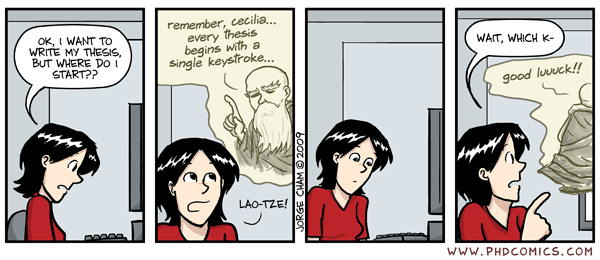
Of course, to get there you have to start....


Wednesday, November 20, 2013

When its not "hip to be square": A short how to guide for shape cropping your pictures and images

By Lara Sanderson

Chuck away your square sided images! Ditch the rectangle! If you want to know how to change the shape of your image, now you can create hearts, triangles, inverted triangles whatever is in the shape art gallery in MS Word or MS Powerpoint. I thought I would share what Google search shared with me...

Using a photo got from the creative commons website fotopedia- I found a nice image of Lilly of the Valley that I would show you but my computer is quietly having a hissy fit. So in four simple steps


1: Go to drawing tools,
2. Crop function,
3: Crop to shape,
4: Choose your shape and voila!

Enjoy! It makes jazzing up those posters and presentations that much easier when you know how!